We use cookies on our website.
Some of them are necessary for the functioning of the site, but you can decide about others.

Michael Pihach is an award-winning journalist with a keen interest in digital storytelling. In addition to PAX, Michael has also written for CBC Life, Ryerson University Magazine, IN Magazine, and DailyXtra.ca. Michael joins PAX after years of working at popular Canadian television shows, such as Steven and Chris, The Goods and The Marilyn Denis Show.
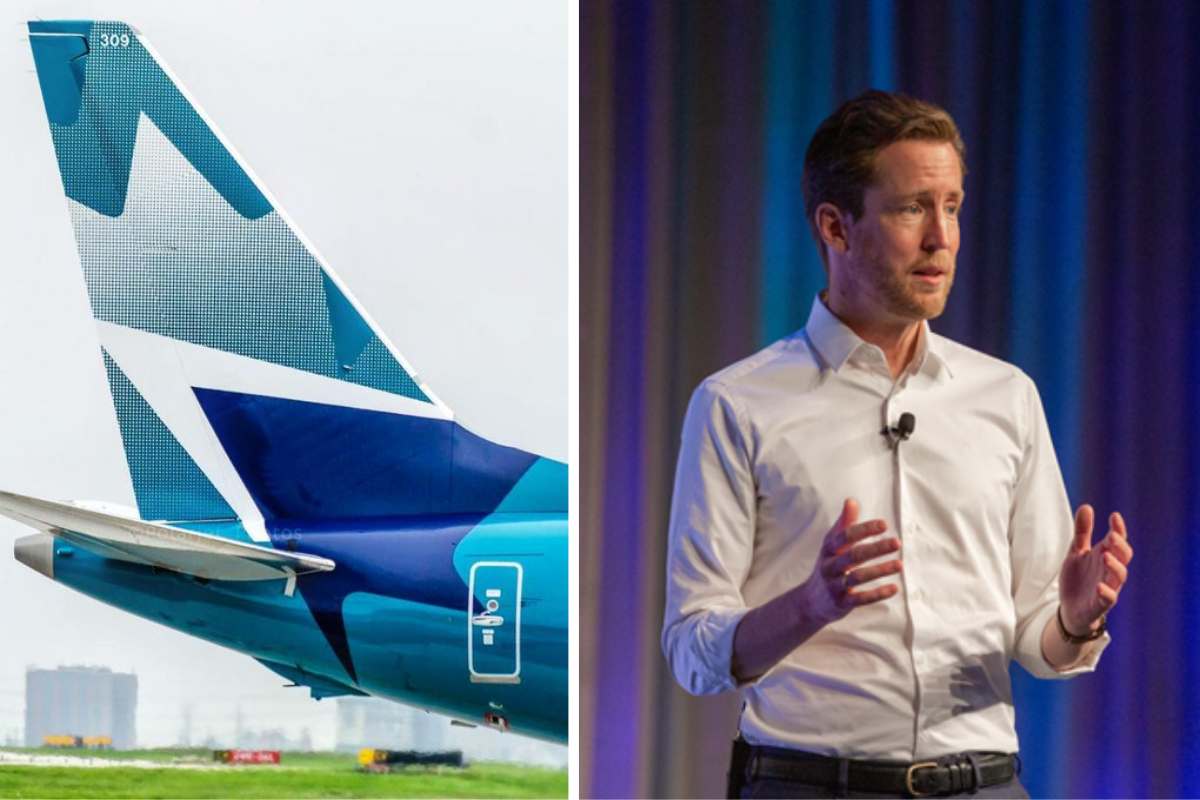
WestJet’s CEO believes that air travel in Canada is viewed as a luxury, but argues it should be recognized as an essential service.
Speaking to the Calgary Chamber of Commerce on Tuesday (May 27), Alexis von Hoensbroech outlined actions Ottawa could take to make air travel more affordable for Canadians, beginning with lowering fees.
“Canada is a country that needs air travel more than almost any other country,” said von Hoensbroech, as reported by the Calgary Herald.
In Canada, government fees and infrastructure charges add up to $133 on a plane ticket, covering sales tax, navigation fees, airport improvement fees, and security charges.
“If we look south of the border…it’s significantly less,” said von Hoensbroech, sharing data that the cost in the U.S. is $49, including excise tax and segment fees, a passenger facility charge and security fees.
Lowering fees to U.S. levels would “stimulate enough demand” to feed another airline the size of WestJet, he suggested.
He said it's "fundamentally wrong" for air travel not to be considered essential in a country where many communities rely on it as their only link to the outside world.
“If the government wants to unite Canada and take down internal trade barriers, then reducing the cost of air travel by reducing fees that are imposed on air travel and ultimately make tickets cheaper would be the right thing to do,” von Hoensbroech reportedy told journalists.

“Right now, there are millions of Canadians that cannot afford an air ticket, and a lot of this is because of the infrastructure costs and fees and charges are so high, and so much higher than in most other countries.”
In his speech, von Hoensbroech questioned why the federal government supports transportation infrastructure such as bridges, passenger rail, and ferries, yet places numerous costs on the airline industry—costs that ultimately get passed on to travellers.
READ MORE: “It’s not rocket science”: WestJet CEO reiterates call to improve air travel in Canada
“We need to build Canada — now even more than in the past — and aviation plays a key role” he said.
Von Hoensbroech said WestJet fares are half what they were 30 years ago, adjusted for inflation — but government fees and taxes have climbed by two-thirds
“The fact that this is so high is a barrier to flying for millions and millions of Canadians, because they cannot afford (to),” he said.
He noted a World Economic Forum study that ranked air ticket price competitiveness in Canada 101st out of 119 countries.
“This is not because airlines are evil, this is because there is such a high floor of fees and charges,” he said.
Passenger compensation for unexpected delays is another regulatory obstacle, according to von Hoensbroech.
“Guests should have the option to choose whether (they) want the compensation or (they) maybe don’t take the compensation, but you get cheaper airfare,” he said.
A review of the funding structure for the air sector was also proposed. Von Hoensbroech highlighted that while major rail projects in eastern Canada receive tens of billions in government subsidies, airlines do not benefit from similar support.
He believes Ottawa should not subsidize the air sector directly but instead should look to other countries and “learn from the best.”
According to von Hoensbroech, there is a clear imbalance since the air sector is entirely funded by users, while other modes of transportation receive subsidies.
Separately, he addressed the risk posed by potential U.S. tariffs and the possibility that Canada might respond with retaliatory tariffs on American-made goods.
“We are not subject to tariffs that the U.S. may impose, because passenger tickets are never subject to tariffs,” said von Hoensbroech.
He noted that WestJet would feel the impact if Canada retaliated against U.S. trade duties, pointing to their agreement to purchase Boeing 737 planes from the U.S., each costing more than US$100 million.
“We don’t quite pay this price, but it is expensive. So you add 25 per cent to this, and you do this multiple times a year . . . next year, we expect more than 20 aircraft deliveries,” he said.
“Do the math, this could be a real problem.”
The CEOs insights come amid growing calls from business leaders to reduce internal trade barriers as the U.S. becomes a less dependable partner.
In response to U.S. President Donald Trump’s tariffs, his remarks about making Canada the “51st state,” and his treatment of marginalized groups, many Canadians are rethinking travel to the U.S., choosing to stay within Canada – or explore other destinations abroad.
READ MORE: U.S. inbound travel continues to decline amid shifting sentiment
According to Von Hoensbroech, upcoming bookings at WestJet indicate a decline in cross-border travel with the U.S. by a "mid-to-high-teens" percentage compared to last year, with more Canadians now flying to Europe and the Caribbean.
Airlines continue to adjust their transborder operations as international sentiment toward the U.S. continues to be undermined by several factors.
Prominent among these are policy announcements under the Trump administration, including proposed tariffs targeting long-time trade partners, including Canada.
READ MORE: "We get it": Meet the American who’s standing up for Canada-U.S. travel in Washington
A weak Canadian dollar and widespread media coverage of border security incidents and national travel advisories have further contributed to a negative image abroad.
"Shifting sentiment and perceptions of the U.S. are expected to continue to weigh heavily on travel demand," said Aran Ryan, director of industry studies at Tourism Economics, in a press release last week.
The downturn is particularly pronounced in Canada.
Canadian arrivals have plummeted by 20.2 per cent, with land border crossings in April dropping a staggering 35.2 per cent compared to the previous year, reports Statistics Canada. Air travel from Canada fell by 19.9 per cent over the same period.
As previously reported, WestJet’s rival Air Canada plans to discontinue five cross-border routes to the United States for the winter 2025–26 season.
The cancelled flights are at key Canadian hubs—Toronto (YYZ), Montreal-Trudeau (YUL), and Vancouver (YVR)—to five U.S. cities: Detroit (DTW), Indianapolis (IND), Minneapolis (MSP), Nashville (BNA), and Tampa (TPA).
Don't miss a single travel story: subscribe to PAX today! Click here to follow PAX on Facebook.


