We use cookies on our website.
Some of them are necessary for the functioning of the site, but you can decide about others.


Michael Pihach is an award-winning journalist with a keen interest in digital storytelling. In addition to PAX, Michael has also written for CBC Life, Ryerson University Magazine, IN Magazine, and DailyXtra.ca. Michael joins PAX after years of working at popular Canadian television shows, such as Steven and Chris, The Goods and The Marilyn Denis Show.
A new report from the Competition Bureau recommends that Canada ease restrictions on foreign ownership of domestic airlines and allow foreign-owned carriers to fly domestic routes.
Released Thursday (June 19), the report on competition within the airline industry advocates for a “Leverage (of) international capital and experience to strengthen domestic competition,” including through raised ownership caps for investors outside Canada.
The Bureau suggests increasing the limit on foreign ownership by a single investor in airlines from the current 25 per cent to 49 per cent for most airlines.
For "domestic-only Canadian airlines," it recommends allowing up to 100 per cent foreign ownership.
This would require the creation of a new category of airline, a model the Bureau notes has worked well in Australia’s aviation sector.
“With the right policy changes, governments can create the conditions for new airlines to grow and compete – and give Canadians access to more affordable, reliable options for flights. With this report, we have identified concrete actions that governments can take to achieve these goals,” said Matthew Boswell, Commissioner of Competition, in a statement.
It’s one of many recommendations listed in the study titled, “Cleared for take-off: Elevating airline competition.”
The airline market study launched last summer to better understand competition issues in the industry and examine what changes can be made to improve competition in Canadian aviation.

During the study, the Bureau engaged with more than 120 stakeholders, including airlines, airports, travel and tourism companies, government organizations, consumer advocacy groups, labour representatives, corporate customers, and industry experts.
More than 1,500 Canadians also shared their views through a public consultation.
The Bureau’s report outlines three areas of focus for governments to create the right conditions for competition in the industry.
In addition to reducing barriers on foreign ownership, the report recommends prioritizing competition in Canada’s aviation policy, including in the review of airline mergers and collaborations.
It also advocates for supporting northern and remote market access, including tailoring regulations to a northern context.
More competition in the airline industry would mean lower prices, more options and better service for Canadians, the Bureau says.
When just one new competitor flies on a route between two cities, airfares go down by nine per cent on average, the report reads.
Currently, between 56 and 78 per cent of domestic air travel through Canada's major airports is handled by Air Canada and WestJet, the report says.
According to the study, these airlines have gradually divided the market geographically—Air Canada dominating the east and WestJet the west—resulting in reduced competition even between them.
The Bureau points to a restrictive environment for international players as a key issue—specifically, limitations on non-Canadian airlines operating domestic routes and restrictions on foreign investment.
These barriers, it says, make it harder for smaller or emerging Canadian airlines to grow.
“Reconsidering these restrictions would unlock new capital sources for Canadian airlines. This in turn will stimulate greater competition and innovation in the domestic market,” the report reads.
The Bureau highlights early indications of increasing competition.
Smaller airlines like Porter and Flair are each nearing a 10 per cent share of the domestic passenger market. However, the report cautions that these advances are still “fragile” and have been achieved despite significant challenges in the industry.
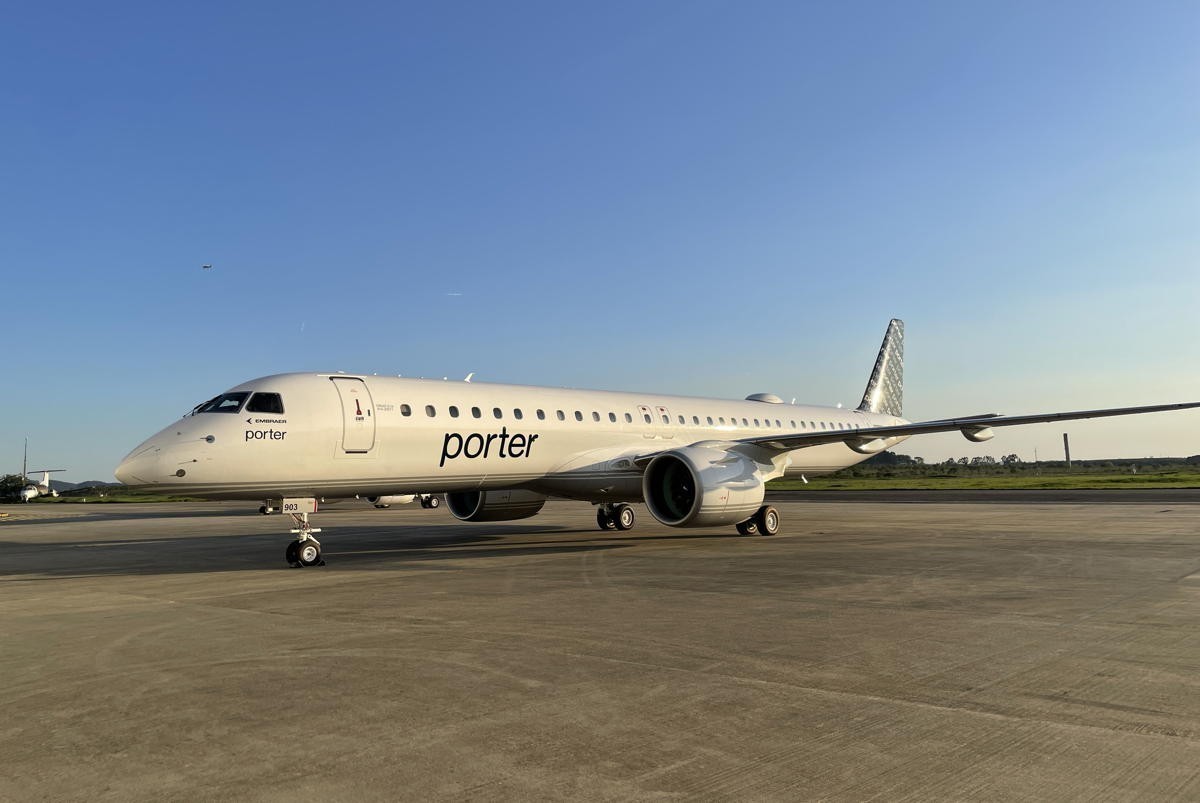
“New airlines face daunting challenges both entering the market and growing into competitors that last long term,” the report says. “Some barriers for these entrants just naturally occur. But others could be addressed through policy changes.”
The report also suggests reducing “user fees,” which currently take up to 30 per cent of ticket revenue to cover infrastructure costs such as security, navigation, and airport terminals.
Lowering fees could help budget airlines offer cheaper fares and attract more passengers, the report suggests.
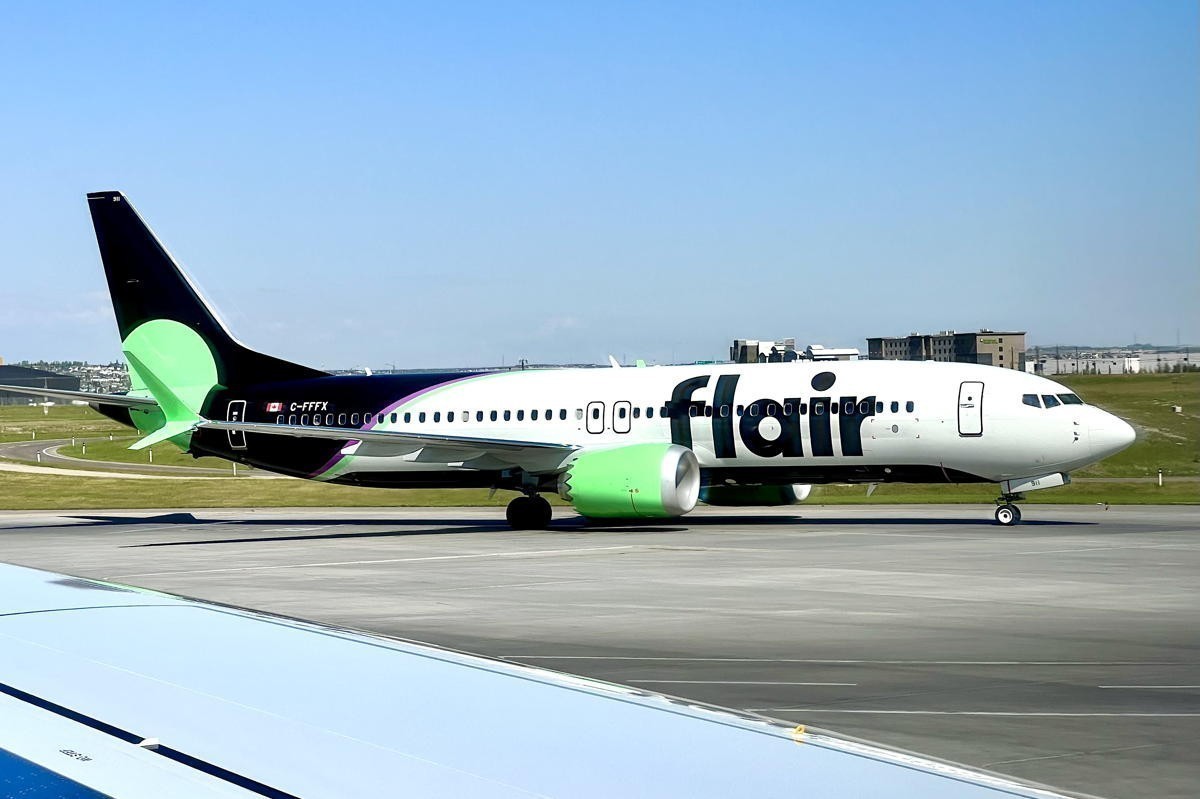
However, the study points out that if the government increases subsidies to cover these costs instead, the financial burden would simply be transferred elsewhere.
Beyond financial challenges, logistical resources such as takeoff slots, gate access, and check-in counters are often unfairly given to established airlines, creating additional obstacles for new competitors trying to enter the market, the report says.
In response to the Bureau’s study, Air Canada has posted additional context about airline competition and the issues at hand, such as the price of air travel.
Canada’s flag carrier, which, alongside WestJet, was called on the Competition Bureau to provide information for the study, clarified that it is “supportive of initiatives to strengthen the Canadian airline industry."
Still, as shared in a slideshow published early Thursday, the airline says there are “myths and facts” to consider when discussing airline competition in Canada.
According to Air Canada, the belief that there’s a lack of competition in the Canadian air travel industry is a “myth.”
“Canadians have greater choice than ever before on the vast majority of routes they travel,” the airline says.
Canada’s relatively small population and vast geographic area contribute to shaping unique market dynamics in air travel, Air Canada says.

“Most air travellers in Canada fly between a small number of cities compared to other countries,” the airline says, noting that about 75 per cent of air travellers in Canada fly between the top 50 cities.
In the U.S., around 20 per cent of travellers fly between the top 50 cities, and in the EU the number is 13 per cent.
In Canada, the routes served by two (or fewer) non-stop carriers generally involve very small weekly traffic, the airline says.
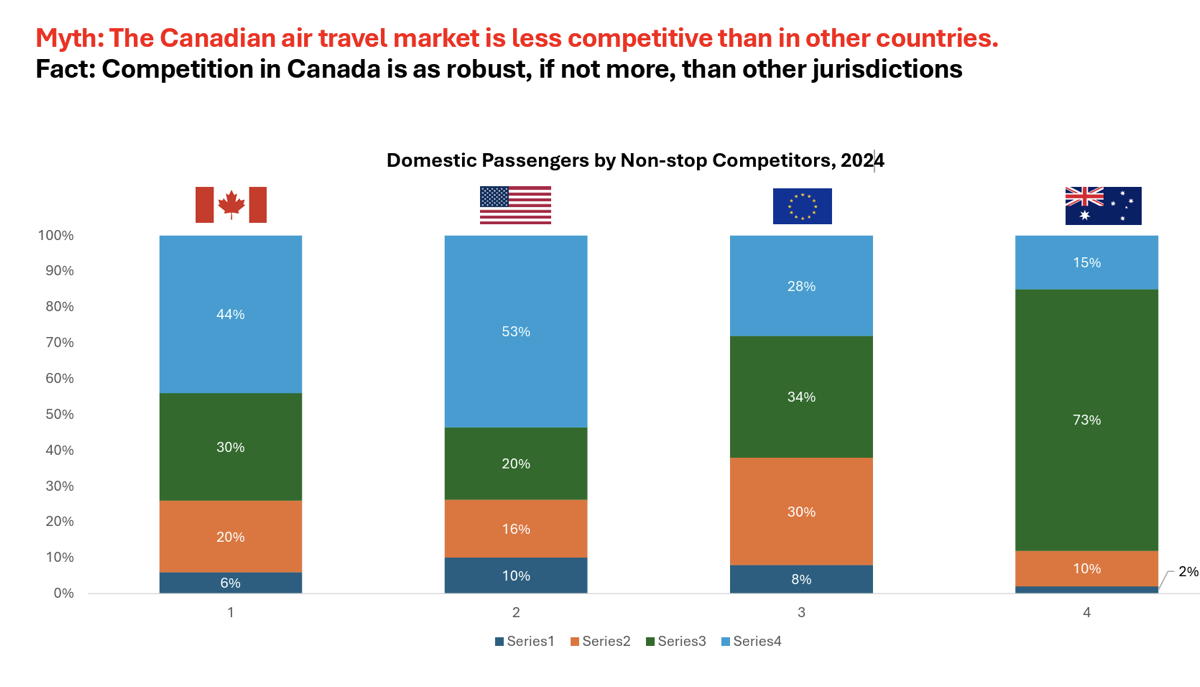
The notion that Canadian air travel market is less competitive than in other countries is another myth, says Air Canada.
The company says competition in Canada is “as robust, if not more, than other jurisdictions,” showing domestic travel comparisons to the U.S., EU and UK.
The idea that small carriers cannot succeed in the Canadian air travel market is another myth, says Air Canada.
“Smaller carriers are seeing the most rapid growth in Canada, and are making up a larger share of the domestic market,” the airline says, citing Cirium data that shows significant domestic capacity changes in 2024 versus 2019 (which includes data from Lynx, a low-cost carrier that folded last year).
Air Canada also addresses the claim that its presence (and WestJet’s) at Canadian hubs is too big.
“Many main carriers have a strong presence at their respective hubs, and Air Canada and WestJet have a smaller share at hubs than global competitors,” says Air Canada. “Investing in hubs helps network carriers develop world-class global connections.”
The suggestion that the price of airfares in Canada is continuously increasing is also a myth, says Air Canada.
“There has been a consistent drop in inflation-adjusted airfares in Canada, and more people are travelling in Canada,” the airline says, citing an analysis of Sabre GDD, Bank of Canada indicators, and CAD/USD average yearly foreign currency exchange rates.
Saying that airfares in Canada have risen considerably after the pandemic is another myth, says Air Canada.
“Since 2019, airfares have increased less than inflation, and far less than other items,” the airline says, sharing a breakdown of items from the Consumer Price Index.
The notion that the lack of competition is the main cause of high fares in Canada is also a "myth."
“Higher and increasing third-party and government taxes, charges and fees contribute to the higher cost of air travel in Canada vs other countries,” the airline says, echoing an argument that WestJet’s CEO, Alexis von Hoensbroech, has previously made.
Air Canada also addresses the argument that taxation has little effect on air traffic demand.
However, in reality, “reducing government and third-party taxes, charges and fees will stimulate air travel in Canada,” the carrier says.
To view Air Canada’s complete slideshow, click here.
Don't miss a single travel story: subscribe to PAX today! Click here to follow PAX on Facebook.