We use cookies on our website.
Some of them are necessary for the functioning of the site, but you can decide about others.


Michael Pihach is an award-winning journalist with a keen interest in digital storytelling. In addition to PAX, Michael has also written for CBC Life, Ryerson University Magazine, IN Magazine, and DailyXtra.ca. Michael joins PAX after years of working at popular Canadian television shows, such as Steven and Chris, The Goods and The Marilyn Denis Show.
Despite the fact that the United States has the highest case count of COVID-19 in the world, some die-hard Canadian snowbirds are still planning to head south this winter come hell or high water.
And to those individuals that are planning to do so, the Government of Canada has a message for you: stay home.
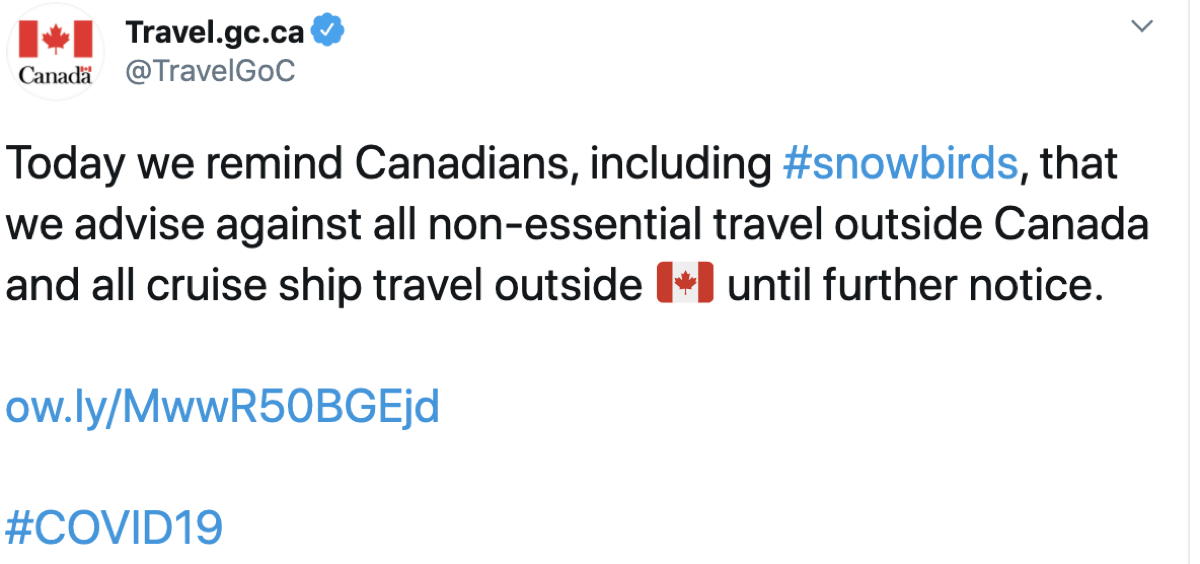
The government took to its travel advisory account on Twitter on Thursday (Oct. 1st) to remind Canadians that a non-essential travel ban is still in place, and that snowbirds, specifically, are not excluded from the advisory.
“Today we remind Canadians, including #snowbirds, that we advise against all non-essential travel outside Canada and all cruise ship travel outside Flag of Canada until further notice,” Ottawa tweeted, attaching a link to Canada’s official travel advice and advisory landing page.
Florida, a popular spot for Canadians, added more than 2,600 new COVID-19 cases and reported more than 130 new virus-related deaths on Thursday, bringing Florida's total to 709,144, according to a daily report released by the state's Department of Health.
Snowbirds can technically do what they want this winter. Despite Ottawa’s ongoing travel warnings and advisories, Canadians are still able to travel out of country (just as long wherever they’re going is open for tourism).
It’s getting to sunny hot spots like Florida or Arizona that may be tricky for some.
The Canada-U.S. land border is still closed to non-essential traffic until at least Oct. 21st, and it’s believed that it will stay this way well beyond that date, possibly into the New Year.
There is a much-publicized loophole to this, of course, as the air border between Canada and the U.S. is open and has been for some time now.
Canadians can travel to the U.S. during the pandemic for leisure purposes (despite the government’s plea not too). However, it doesn’t work both ways. Most Americans can’t enter Canada, either by land or air.
Still, some Canadian snowbirds aren’t letting a global pandemic like COVID-19 cramp their sunny ways.
As reported in a recent story by CBC, some people are still determined to head south in the coming weeks.

One individual CBC profiled was a woman living in a trailer at a campground in Niagara Falls, ON, who doesn’t own a winter home in Canada (nor winter clothes for that matter).
"There's no way I am staying here," this individual told CBC. "Even if I had to get on the plane buck-naked, I'd be on it."
The Canadian Snowbird Association, which has more than 110,000 members, told CBC that it’s hard to gauge right now exactly how many Canadians are, in fact, heading south this winter season.
While some have likely scrapped their plans, others are waiting to see what happens at the border before they make an official decision, the association suggested.
The land border remaining closed might, presumably, keep some snowbirds home due to the high costs associated with shipping a car into the U.S. or renting a car for several months to get around.
Several Canadian insurance companies are now offering COVID-19 travel coverage, with some specifically targeting the snowbird market.
Medipac Travel Insurance, which unveiled a COVID-friendly travel plan in July, offers policies for out-of-country emergency coverage that includes COVID-related claims.
Speaking to the Globe and Mail on July 22nd, Christopher Davidge, vice-president of marketing for Medipac, said many Canadian snowbirds travel south and own homes in the U.S., and are able to practice physical distancing “just as effectively abroad as they are here in Canada.”
While aware of the high numbers of COVID-19 cases in the U.S., “...We do not think the risks will impact the particular demographic of our clients,” Davidge said at the time. “These individuals tend to be more mature, are more aware of the virus and the preventive measures that should be taken while travelling.”
Don't miss a single travel story: subscribe to PAX today!