We use cookies on our website.
Some of them are necessary for the functioning of the site, but you can decide about others.
Amid criticism over an apparent shortage of air traffic controllers, Nav Canada has launched a social media account that tracks flight delays at airports.
As reported by CBC News, the account has been active on the X platform (formerly known as Twitter) since Friday (July 28).
The move comes as delays continue to plague major airports in Canada, and some are blaming it on staffing shortages at the air navigation provider.
"Nav Canada knows that whatever the cause, delays are frustrating for travellers," the private corporation wrote in a statement. "This is why we are implementing a new communication protocol…to ensure air passengers have access to accurate and timely information."
READ MORE: New research shows Canadian airline flight delays worse than U.S. counterparts
Nav Canada, which manages the country’s network of air traffic control towers, will use the new account to share information about flight delays at Vancouver International Airport, Calgary International Airport, Toronto Pearson International Airport and Montréal-Trudeau International Airport.
The account fired up on Friday to report a delay in Montreal due to weather.
Air traffic control delays can be caused by many factors, including bad weather, construction, and operational capacity at airports and airlines, says Nav Canada.
"Delays can become necessary to safely balance demand to ensure airport infrastructure such as runways, taxiways and gates, the busy airspace that surrounds it and the staff of various aviation organizations does not exceed their capacity, the corporation wrote in an explainer posted online.
READ MORE: “Frustrating!” WestJet CEO blasts air traffic control for flight delay
It cited one example.
"On rainy day it may take the pilot of an aircraft a little more distance on the runway to brake, slow down and exit on to one of the taxiways. That extra time on the runway means that air traffic controllers have to slow down the next aircraft to ensure safe distancing. A similar situation occurs when a small aircraft is following a large aircraft – the smaller aircraft is affected by wake turbulence and therefore needs to be spaced out more for safety."
“These interactions between two aircraft are business as usual but start multiplying these tactical situations by hundreds of aircraft over several hours and we have a compounding impact,” said Jonathan Bagg, director of stakeholder and industry relations at Nav Canada. “There are many, many interactions like this in Canada’s aviation system that happen every day. They create delays – even when every part of the system has all their ducks - or planes - in a row."
“Delays in the air transport system are a global phenomenon, but certain aspects of the Canadian ecosystem are unique. Our vast distances make us more reliant on air transportation than most countries. Our weather can be very harsh and challenging, and it can take us more time to recover from disruption compared to countries where infrastructure, equipment and resources are less spread out geographically.”
Last month, WestJet’s CEO Alexis von Hoensbroech publicly called out Nav Canada for being understaffed.
von Hoensbroech vented his frustrations on Twitter (which the platform was called at the time) from the seat of a WestJet flight he was on that was running 2.5 hours behind.
"Frustrating!” wrote the CEO, posting a picture of himself, with a grumpy face, from a middle seat. “Delayed by 2.5h on our own @WestJet flight to @yvrairport because @navcanada is understaffed. We would have been perfectly on time, now many guests will miss their connections. Shows again why we need a proper shared accountability system across the entire sector!”
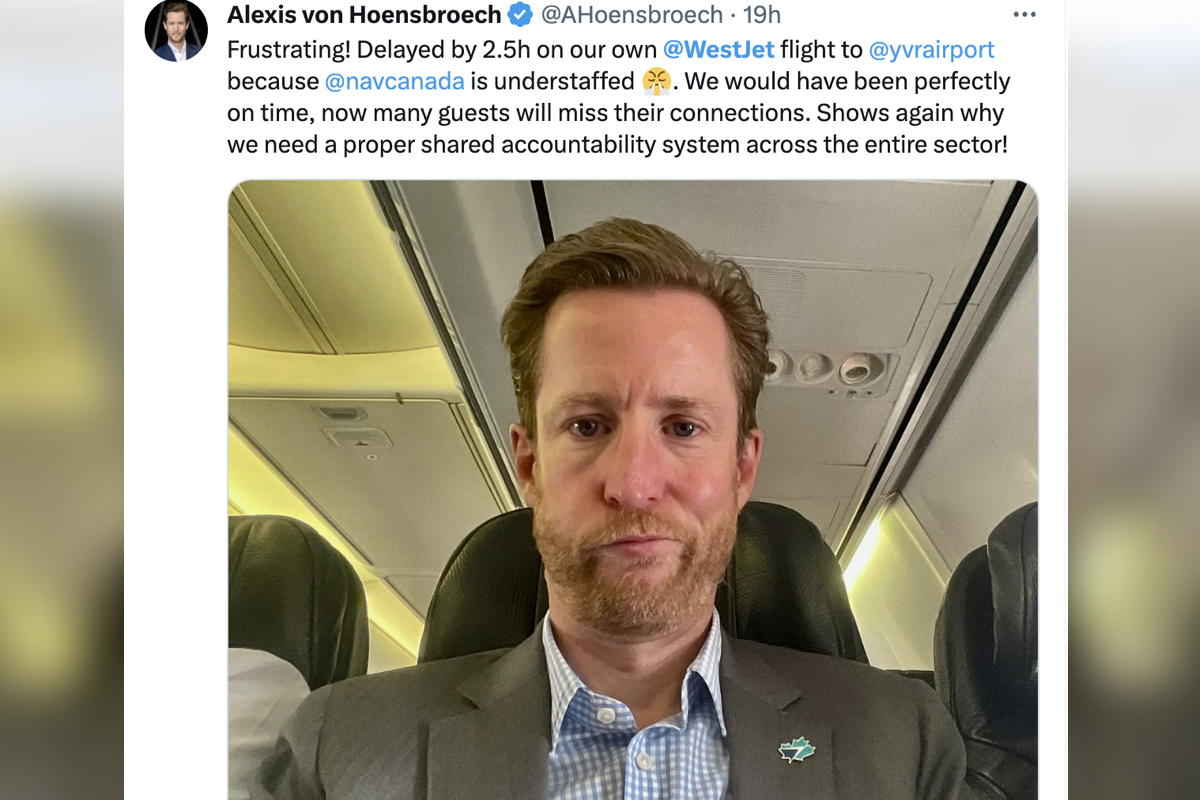
von Hoensbroech’s tweet aligned with an argument that WestJet has been making for a while now – especially amid reforms to Canada’s Air Passenger Protection Regulations (APPR) – and that is that airlines should not be the only ones held responsible for delays and cancellations
WestJet’s leadership has long been calling on Ottawa to address what it calls a “glaring gap” in consumer protection, and to implement a system that recognizes shared accountability in air travel.
von Hoensbroech has previously voiced his support for APPR legislation, which states how airlines must communicate and reimburse or compensate customers for delayed or cancelled flights or for damaged luggage.
But the CEO believes airlines aren’t the only ones to blame.
“There's airports, there's navigation, there's security, there's border control, there's ground handlers," von Hoensbroech told media last February, noting that those departments aren’t subject to the same rules and regulations as airlines.
“Whatever happens, it's always the airline, and the airline basically becomes the insurance company for the entire industry,” the CEO said at the time. “If you want an aviation sector that collectively produces a reliable product for our guests, then there has to be some shared accountability.''
In response to von Hoensbroech’s seat tweet, Nav Canada, last month, said staff-related delays only represent a “small portion” of flight disruptions.
“When it comes to air traffic delays, many factors come into play,” a rep told Daily Hive at the time, citing infrastructure maintenance, runway construction and weather as the most frequent source of delays.
Recent figures released by Cirium, an aviation data firm, show Canada's two biggest airlines are reporting more delays this summer compared to airlines in the U.S.
As previously reported, from June 19 to July 16, about half of Air Canada's 31,168 flights arrived on time, while 64 per cent of WestJet's 14,998 flights arrived behind schedule.
The standard for being considered "on time" is reaching the airport within 15 minutes of the scheduled arrival time.
Comparatively, the five major airlines in the United States reported on-time performances ranging from 68 per cent to 83 per cent during the same period.
The data also reveals a decline in punctuality as flight numbers have increased for Canadian airlines.
In May, Air Canada achieved 70 per cent on-time performance, which dropped to 53 per cent in June.
Similarly, WestJet's on-time performance in the previous month was 67 per cent.
Don't miss a single travel story: subscribe to PAX today! Click here to follow PAX on Facebook.