We use cookies on our website.
Some of them are necessary for the functioning of the site, but you can decide about others.

 When I wake before 5 a.m., I tell myself it’s jetlag.
When I can’t go back to sleep, I tell myself I’m just keen to catch the first rays of light as they hit Makana Mountain on Kauai’s north shore. But that’s just what I’m telling myself. The truth is, I’m thinking about Charlie.
Charlie and I met at summer camp. We had some things in common – for one, we were both pretty scrappy and since we were the smallest in our respective groups, we were forced to work together more than once. But from the very first day, it was clear we were never going to be friends.
By the end of our relationship, Charlie had caused me plenty of frustration and tears. Here’s the thing about Charlie: he was a horse. Charlie liked my attitude about as much as I liked his. We fought constantly, so I was already pretty frustrated when he finally threw me off his back. When I hit the ground hard, I was scared and angry, and I never wanted to ride a horse – any horse – again.
Now, 25 years later, it’s time to get back in the saddle. As I approach Kauai’s Princeville Ranch Adventures – where I’m about to e ku paniolo or “cowboy up” – Charlie is still firmly on my mind, and I try to settle my nerves; a nervous rider makes for a nervous horse, and that’s the last thing I need.
I put on my game face and stroll across the pasture to the picnic table where my companions and I meet our guide, Vance Borden, and equine manager Eileen Donohue, who will accompany us on our half-day waterfall picnic ride.
As we settle in for a quick horsemanship lesson, Donohue offers a round of her home-made iced tea and a clipped branch covered in fresh lychees. I’ve never actually seen a lychee that didn’t come in a can and the momentary distraction is just what I need.
Soon, Borden is giving us a safety lesson and explaining the basics of riding: Hold the reins like this. Here’s how to turn. The horse he uses to demonstrate moves slowly, and Borden jokes that its batteries are running low.
I think that horse looks like it’s just my speed. “Anyone nervous?” he asks. I sheepishly raise my hand but I’m sitting in the back and I don’t think anyone sees. Regardless, my companions all know how I feel; I talk too much when I’m nervous, and I’ve been talking about Charlie all morning. Someone asks the names of the horses and my ears pick up when I hear there’s one named Blueberry. I instantly want to ride him. Newberry on Blueberry. How perfect would that be?
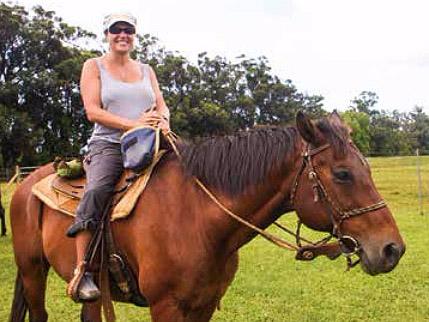
But it turns out I’m assigned to Keoke – the "low-batteries" horse from the demonstration. While I like his speed, this horse seems huge – I’m sure I’ll make a fool of myself as I try to get on. Still, I do as I’m told: I put one foot in the stirrup, swing the other over and just like that, I’m in the saddle. This is it. I’m riding a horse.
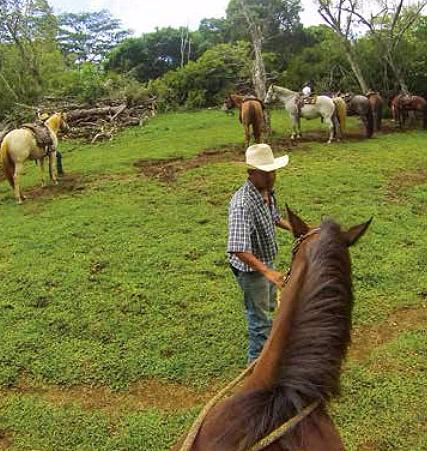
Keoke is undeniably beautiful. He’s rich brown, with a darker mane. “The only thing about this guy,” Borden says, “is he likes to put his head down and eat the grass. You can’t let him do that.” Great, I think. Another problem horse! How am I going to keep him in line?
It turns out I don’t have to – he never puts his head down. Not once. And while he starts the ride with an ongoing series of snorts that jangles my nerves, it turns out he just has allergies. I feel like we’re gelling pretty well. I ask about Keoke’s name, and I learn it’s the Hawaiian form of George. Okay, I think. Big George and I are going to get along just fine.
And we do, too. We stroll through a working cattle pasture, mountains on one side, ocean on the other. While the Princeville Ranch that gives the name to Princeville Ranch Adventures is clearly a tourist destination, offering ziplines and off-road ATV adventures in addition to horse tours, it’s also one of the oldest working cattle ranches in Hawaii, established more than 180 years ago. The Carswell family, which has operated the stables at Princeville Ranch since 1978, has deep ties to this place. Their great uncle A.S. Wilcox owned the property from the 1890s to the late 1910s. Princeville Ranch Adventures is still a family-run operation, receiving the 2012 Kauai Family-owned Business of the Year award from the U.S. Small Business Administration.
Donohue has worked at the ranch for 20 years, and she is clearly passionate about the land and the animals it sustains. She explains that its 300 head of cattle graze on the fields we’re riding through, moving from pasture to pasture throughout the year. Sure enough, we walk our horses past two of the cattle out grazing – stragglers left behind from the herd. In the open field, we let the horses spread out, but soon we approach a curving downward trail and we have to put them into single file. I’m stunned when Keoke goes exactly where I tell him, falling politely in line and obeying my instructions to maintain the appropriate distance.
“Don’t panic if your horse stumbles,” Donohue says to the group. “They know what they’re doing and they don’t want to fall any more than you want them to.”
An hour ago this would have terrified me. But I realize in this moment that I trust Keoke completely. He does stumble a little, but he doesn’t seem worried, and just as Charlie’s bad attitude rubbed off on me (or mine on him), Keoke’s gentle confidence fills me with a sense of calm.
After about 40 minutes of riding, we reach a clearing where we dismount. The horses will wait here while we explore some steeper trails on foot. We climb straight up a set of stairs cut into the trail – a “Hawaiian Stairmaster,” Donohue says – and then straight down. This is serious business – there are ropes to hang onto, and I have to take some steps sideways. The views over a rainforest valley are breathtaking, and it’s clear why so many movies are filmed in Kauai’s vast undeveloped countryside. Soon, we emerge from the forest and we’ve arrived at Kalihiwai Falls – a name that quite appropriately translates to “water on the edge.”
It’s a still, blue rock-lined pool with an impressive 25-metre waterfall. After snapping a few photos, we’re all keen to jump in. As we swim in the bracing waters, Donohue and Borden prepare our picnic, which summons the chickens. Kauai has a thriving chicken population, descended from escaped domestic chickens that flew their broken coops in the wreckage of Hurricane Iniki in 1992. While some view them as a nuisance, they have become part of the island’s character, and the truth is they are surprisingly beautiful birds. Our bellies full, we’re off again, this time decked out in light climbing gear and carabiners. That’s because we’re about to walk across a waterfall and climb a three-metre rock wall. Clipping on the safety lines, everyone makes it without stumbling or getting wet, and soon we’re back to the horses.
I’m actually glad to see Keoke, standing there composed and waiting. This time, I’m confident as I mount the saddle and we’re back on our way. I find my posture is different, more relaxed, and my hips and ankles are loose and able to move with Keoke as he walks. I can suddenly see why people are so passionate about these beautiful creatures.
When we get back to the ranchhouse, we snap a few photos with our horses and it’s time to call it a day. I’m surprised to find myself wishing it could have lasted longer. I’m finally over Charlie. Keoke has stolen my heart.