We use cookies on our website.
Some of them are necessary for the functioning of the site, but you can decide about others.

“Our risk tolerance just got a little higher,” Darrell Wade, CEO & co-founder of Intrepid Travel, jokes, sitting down with PAX in the company’s Toronto office.
It’s been nearly two months since Intrepid Group parted ways with TUI Group, ending their four-year PEAK Adventure Travel Group strategic venture and reverting back to private ownership. Both parties maintain that the split was a mutual decision made to allow each to attend to their respective markets, and as further explained by Wade, was the product of “philosophical differences regarding the way forward.”
“I like to take a fairly long-term view – and a multi-stakeholder view – toward what we want to achieve,” he continues, emphasizing that the return to full ownership of the adventure brand he co-founded with Geoff Manchester in 1989 (along with the portfolio of brands that make up the Intrepid Group) ultimately means more flexibility to pursue its "purpose beyond profit" credo.
“It’s something we’ve always done and it’s something that’s always worked for us,” Wade says in reference to the company’s focus on responsible tourism, before pointing out that Intrepid had a 28 per cent compound average growth rate between 2000 and 2010 – which dipped into the single digits from 2011 to 2015 while under the joint venture.
“When the focus went off it in the last four years, various other things didn’t work for us as well.”
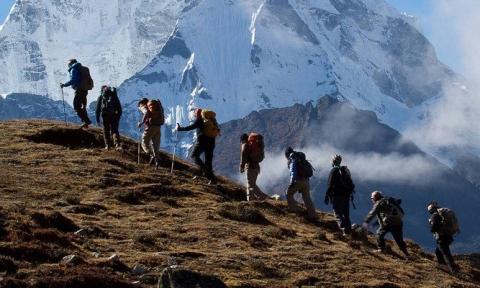
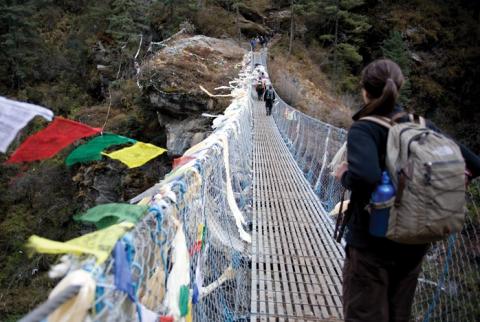
And Intrepid was quick to make up for lost time; two weeks before the end of the PEAK partnership, Wade penned an open letter to travellers announcing that in the wake of the earthquake in Nepal, the adventure travel brand would donate all profits from its 2015-2016 Nepal season back to the country, via The Intrepid Foundation, its not-for-profit organization.
“We were reasonably confident from late January, early February that the split was going to happen,” Wade shares, “so we started to get back into the groove of asking, ‘What can we do that might have a bit of an impact on the world… that might send out a positive message to our clients?’”
The answer came about after Wade attended a staff meeting in Nepal following the disaster, when 70-80 Intrepid employees expressed concern over the future of the country’s tourism market – and what would happen to them if it didn’t bounce back.
In response, Intrepid Travel began a fundraising program, launched a Charity Trek product and provided support to a safety assessment, in addition to its profit donations. It has also partnered with NGOs such as Plan International and WWF for a Return Nepal campaign.
Altruistic efforts aside, Wade views it as a sort of experiment in stimulating the market and an investment in their own interests as a company, with stakes in the success of the country’s tourism. He’s also conducting a comparison exercise at the same time, leaving Peregrine Adventures (Intrepid’s second brand offering adventure tours in Nepal) to its own devices.
“You’ve got to prove your case,” he says, explaining that measuring the success of both brands in a scenario like this is a way to validate committing a business’s profits to a cause. “You can have a line like ‘purpose beyond profit,’ but you’ve got to actually show people how and why and when it works. If you do the same thing across the board, well, you’ll never really know.”
It’s the kind of internal research that comes easier to unlisted companies, and although Wade credits the partnership with TUI for the adoption of beneficial new systems, policies and travel brands (the Intrepid Group is now comprised of Adventure Tours Australia, Intrepid Travel, Geckos Adventures, Peregrine Adventures, The Family Adventure Company and Urban Adventures), the executive also admits that Intrepid’s renewed privatization has allowed for a lot more flexibility – and in turn, potential for better industry partnerships.
“It could be just fluke, but there is a recognition of independence,” he says, referring to the tour operator's eight per cent global growth (three per cent in Canada) since ending its partnership with TUI. “People who may not have wanted to deal with us before because we were part of (a large listed company) are now ringing us up. It’s great."
As such, Intrepid is taking a stakeholder-focused approach moving forward, which in addition to increasing its image as a company (Intrepid Group recently applied to become B Corp certified in an effort to enhance its corporate transparency), means it will put an emphasis on its industry partnerships.
“We want to actively use the [travel trade] to grow our business,” he says, maintaining that while direct bookings are offered on the brand’s website, the benefits of working with travel advisors outweigh any costs associated with the practice.
“When we run the data, we always find that [direct bookings] are more expensive than industry partner bookings,” he continues. “Yes, you may pay 10 or 12 per cent commission, and you may have marketing support and you may have to run FAM trips, but you add all that up and compare it to the cost of direct marketing – in our experience, in Canada, industry sales win.”