We use cookies on our website.
Some of them are necessary for the functioning of the site, but you can decide about others.


Michael Pihach is an award-winning journalist with a keen interest in digital storytelling. In addition to PAX, Michael has also written for CBC Life, Ryerson University Magazine, IN Magazine, and DailyXtra.ca. Michael joins PAX after years of working at popular Canadian television shows, such as Steven and Chris, The Goods and The Marilyn Denis Show.
Accounting for roughly three per cent of greenhouse gas emissions worldwide, the global aviation sector is on a mission to decarbonize, with a plan to reach net zero by 2050.
In 2021, the International Air Transport Association (IATA) outlined this green goal, in line with the Paris Agreement global climate treaty.
But aviation, as it faces record-breaking post-COVID demand, is one of the hardest industries to decarbonize. Achieving net-zero commitments won’t be easy and will require credible action.
With electric or hydrogen-powered planes are far from a reality (at least in the near future), aviation is currently turning to sustainable aviation fuel (SAF), a low-carbon fuel made from renewable materials such as used cooking oils or organic waste.
SAF is said to be the most effective way to reduce air travel’s carbon footprint, with potential to almost entirely eliminate net greenhouse gas emissions compared to fossil jet fuel.
It can be blended with conventional jet fuel to meet all certification and safety requirements. It’s a solution that requires no new investments in aircraft engines, infrastructure or distribution.
IATA says the airline industry could require 450 billion litres of SAF annually by 2050 in order to achieve its reduction targets.
The response to SAF, so far, has been mediocre. In 2022, global SAF production was estimated to have been 300 and 450 million litres, which covers less than one per cent of total jet fuel demand.
In Canada, SAF isn't produced on a commercial level at all.
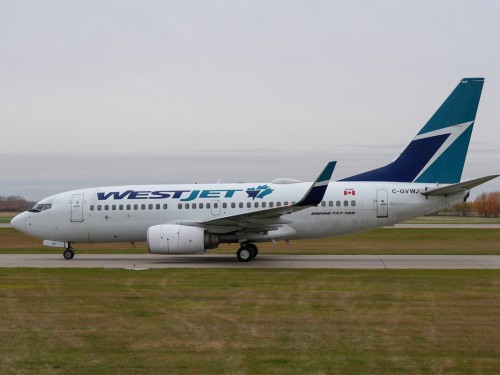
Alexis von Hoensbroech, CEO of WestJet, weighed in on the issue on Tuesday (Sept. 19), speaking at the 24th World Petroleum Congress, an international oil-and-gas conference being held in Calgary this week.
As first reported by the Canadian Press, von Hoensbroech said WestJet is investing billions in fleet improvements and energy efficiency to lessen its environmental impact.
Von Hoensbroech told attendees that airlines are dependent on fossil fuels – Calgary-based WestJet reportedly spends upwards of $1 billion annually on jet fuel.
One could argue that the best way to decarbonize the airline industry is to simply fly less, but Von Hoensbroech doesn’t view that argument as realistic, especially as the global demand for air travel grows.
“The way to net zero is not to fly less. The way to net zero is to make flying sustainable,'' von Hoensbroech was quoted as saying.
The CEO, notably, said the push to decarbonize will eventually result in higher ticket prices – unless governments step in and offer support.
von Hoensbroech said there needs to be incentives both to refiners to produce SAF and to airlines to use it, CP reported.
The United States has a tax credit program to support fuel makers and airlines that use the green fuel, but Canada does not.
von Hoensbroech warned that unless Ottawa lends a hand, the cost of SAF will make air travel cost prohibitive for many.
“Canada needs air travel more than other countries,” the CEO said. “This country should make sure it does not cut off the lifeline to the outside world for thousands of communities.''
Later, in a WestJet press release, von Hoensbroech said Canada has an “enormous opportunity” to further its leadership in energy sustainability through SAF production.
"The time is now for a regulatory framework to create a competitive investment climate for sustainable aviation fuel production, right here in Canada, that keeps air travel affordable and accessible,” the CEO said.
Don't miss a single travel story: subscribe to PAX today! Click here to follow PAX on Facebook.